
Haryana has done well in terms of economic growth over the last couple of decades. For it to continue to lead the growth ladder, the new government has to work hard on multiple dimensions, recommend Shishir Gupta and Rishita Sachdeva.

Since Sanjay Malhotra took office as governor in December, the Reserve Bank of India (RBI) has adopted a more accommodative stance, which bodes well for banking and the economy as they navigate a growth slowdown, according to analysts.

Dr T V Somanathan is the first finance secretary to be appointed Cabinet secretary since 1985. His appointment at this juncture seems to carry much meaning for the forthcoming trajectory of reforms and restructuring of India's steel frame.

The Lower House of Parliament took up the Demands for Grants and Appropriation Bills after two adjournments as the ruling and Opposition MPs engaged in a matching duet over demands for an apology by Rahul Gandhi and the Adani issue.

Macroeconomic management is usually a lot more comfortable with lower fiscal deficits. The sooner we get there, the better for the economy, says former Chief Economic Adviser to the Government of India Shankar Acharya.

'Why has Maharashtra slipped up over the past couple of decades?' 'Not only is this question critical for residents of the state, but given that it accounts for 14% of India's GDP, a faster-growing Maharashtra implies a faster-growing India as well, point out Shishir Gupta and Rishita Sachdeva.

Exports declined for the fourth-consecutive month by 10.3 per cent year-on-year to $34.98 billion in May, while the trade deficit widened to a five-month high of $22.12 billion. According to the data released by the commerce ministry on Thursday, key export sectors recording negative growth include petroleum products, gems and jewellery, engineering goods, ready-made garments of all textiles and chemicals. Imports also declined 6.6 per cent, six-month in a row, to $57.1 billion against $61.13 billion in the same month last year, the data showed.

Govt may further hike excise on petrol, diesel before Budget.

India's gross domestic product grew at a decade low of 5 per cent last fiscal.
.jpg)
The agency's lead analyst Art Woo added that fiscal management is a challenging task.

The Budget, to be presented on February 1, is likely to be less worried about fiscal deficit and will be focused more on nursing the fragile growth, according to a Wall Street brokerage report. Bank of America Securities India expects the budget to peg "fiscal deficit at a high 5 per cent of GDP for FY22 and 7.2 per cent for FY21, as it is likely to step up capex, recap public sector banks, push asset sales to break government monopolies, offer sops for real estate, tax cuts for lower income groups and creation of a bad bank". Its house economists expect these spends to be funded by debt and partly by imposing a cess on high income groups and also by some non-fiscal measures like tapping the central bank's revaluation reserves and bank recapitalisation and infra bonds.

The additional outgo to combat the impact of COVID-19 will significantly erode the fiscal consolidation achieved by the state governments in the past three years, an RBI report said on Tuesday. In its study of the state budgets of 2020-21, the RBI report which has dwelled on the theme 'COVID-19 and its Spatial Dimensions in India', said that Gross Fiscal Deficit (GFD) of the states would spiral during the current fiscal.

India's exports recorded a flat growth of 0.59 per cent to $31.99 billion in November, even as trade deficit widened to $23.89 billion during the month, according to the data released by the government on Thursday. Exports stood at $31.8 billion in November last year. Imports rose by 5.37 per cent to $55.88 billion in November as compared to $53.03 billion in the corresponding month a year ago, the data showed. During April-November 2022, exports rose by 11 per cent to $295.26 billion as against $265.77 billion in the same month last year.

Positive for banking, infra, FMCG and real estate.

Exports in January 2014 stood at $26.89 billion.
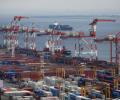
India's merchandise exports in November rose by 26.49 per cent to $29.88 billion on account of healthy growth in sectors such as engineering, petroleum, chemicals and marine products, according to provisional data released by the government on Wednesday. The exports stood at $23.62 billion in November 2020. Imports in November were at $53.15 billion, an increase of 57.18 per cent over $33.81 billion in the same month of 2020, leaving a trade deficit of $23.27 billion.

Eminent economist Arvind Panagariya has said India is on the cusp of returning to a high growth trajectory and voiced confidence that the country will become the world's third-largest economy by 2027-28. Currently, India is the fifth largest economy "so it's another five years.We are already in (the year) 2023. "So 2027-28, India should be the third-largest economy," Panagariya, Columbia University Professor and former Vice Chairman of NITI Aayog, told PTI in an interview in New York.

Investors should view the increase in the LTCG tax rate in conjunction with the increase in capital gains exemption from Rs 1 lakh to Rs 1.25 lakh, which will provide some relief.

Exports rose by 24.22 per cent to a monthly record high of $38.19 billion in April on account of healthy performance by sectors like petroleum products, electronic goods and chemicals, even as trade deficit widened to $20 billion during the month, the commerce ministry said on Tuesday. Imports during the month under review grew by 26.55 per cent to $58.26 billion. The trade deficit in April 2021 was at $15.29 billion.
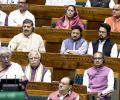
Finance Minister Nirmala Sitharaman on Tuesday announced income tax relief for the middle class, a Rs 2 lakh crore outlay for job creation schemes over the next five years and a spending splurge for states run by her party's new coalition partners as she unveiled the Modi 3.0 government's first budget after the general elections.

Finance Minister Nirmala Sitharaman is likely to strike a fine balance between being fiscally prudent and growth supportive when she presents her fourth straight budget on Tuesday, which is expected to have plans to boost spending to revive investment and create jobs. The Budget for the fiscal year starting April 1, 2022 is likely to raise spending on infrastructure to set the economy on a firmer footing. The stage for the Budget presentation was set by the Economic Survey stating that the government has the fiscal space to do more to support the economy that is forecast to grow at a healthy 8-8.5 per cent growth in the 2022-23 fiscal.

Fiscal mismanagement by states is an issue the union government has to be concerned about as it impacts the nation's economy, the Supreme Court observed on Wednesday and advised the Centre and the Kerala government to iron out their differences on a cap on net borrowing by the southern state.

Budget has several small steps which will boost growth

There was no significant announcement for mutual funds.

The government is likely to present a "run-of-the-mill" budget with an fiscal slippage to 3.7 per cent of the GDP in the next fiscal from an earlier target of 3.5 per cent, a Nomura report says.

Nirmala Sitharaman on Wednesday assumed charge as the Finance and Corporate Affairs Minister for the second consecutive term and is slated to soon present the final Budget for FY '25 that is going to set the tone for the Modi 3.0 government's priorities and direction for Viksit Bharat. Upon her reaching the North Block office, Sitharaman was greeted by Finance Secretary T V Somanathan and other top officials. Minister of State for Finance Pankaj Chaudhary was also present. Chaudhary assumed charge on Tuesday evening.

Fitch on Tuesday affirmed India's sovereign rating at 'BBB-' with a stable outlook, on robust growth and resilient external finances, but said weak public finances remain a challenge. India's rating has been unchanged at 'BBB-', which is the lowest investment grade, since August 2006. "Fitch Ratings has affirmed India's Long-Term Foreign-Currency Issuer Default Rating (IDR) at 'BBB-' with a Stable Outlook," it said in a statement, adding strong growth potential is a key supporting factor for the sovereign rating.

The government has limited room to reduce expenditure without further weakening growth, it noted.

India's economy grew 7.6 per cent in the September quarter of this fiscal and remained the fastest-growing large economy, mainly due to better performance by manufacturing, mining and services sectors, the government data showed on Thursday. The gross domestic product (GDP) expanded by 6.2 per cent in the July-September quarter of 2022-23. India remained the fastest-growing major economy, as China posted a 4.9 per cent growth in July-September 2023.

Sustained dollar demand from importers and banks amid weakness in the equity market and the firming dollar overseas mainly affected the rupee value against the dollar, a forex dealer said.

When Nirmala Sitharaman announced her new privatisation policy, there were serious doubts if the move had the BJP's full political backing. All those doubts were dispelled when her initiatives were endorsed by Modi in Parliament, observes A K Bhattacharya.

Rates India 'BBB-' with a negative outlook.

'If the RBI reduces the rate of interest, housing demand can pick up, investment can pick up, automobile demand can pick up...'

At a pre-Budget meeting, the FM was asked to ensure that NBFCs come out of the liquidity crisis they are facing with the help of RBI. They also spoke about the futility of trying to achieve a 3 per cent fiscal deficit target over the medium term.

'The private sector believes that some enablers in labour-intensive sectors like apparel, toys, tourism, and media retail, can unlock a lot of jobs.'

Arvind Panagariya is widely expected to take a top advisory role in prime minister-elect Narendra Modi's government.
Most economists expect the government to end the fiscal year with a fiscal deficit of 5.6-5.8 per cent which could mean an additional borrowing of 300-500 billion rupees.

Sliding for the fifth straight session, the rupee fell 3 paise to close at a fresh lifetime low of 79.06 against the US dollar on Thursday amid a strong greenback overseas and unrelenting foreign fund outflows. At the interbank forex market, the local unit opened at 78.92 against the greenback and witnessed an intra-day high of 78.90 and a low of 79.07. It finally settled at 79.06, down 3 paise over its previous close of 79.03.

Experts hail Budget 2015 as a progressive, growth oriented one.

Global financial firm J P Morgan has said that it plans to include Indian government bonds (IGBs) or government securities (G-Secs) into its benchmark Emerging Market index from next year, a move that will bring down borrowing cost for the government. The inclusion of the IGBs will be staggered over a 10-month period from June 28, 2024 to March 31, 2025, indicating one per cent increment on its index weight. "India's weight is expected to reach the maximum weight threshold of 10 per cent in the GBI-EM Global Diversified, and approximately 8.7 per cent in the GBI-EM Global index," J P Morgan said in a statement on Friday.
